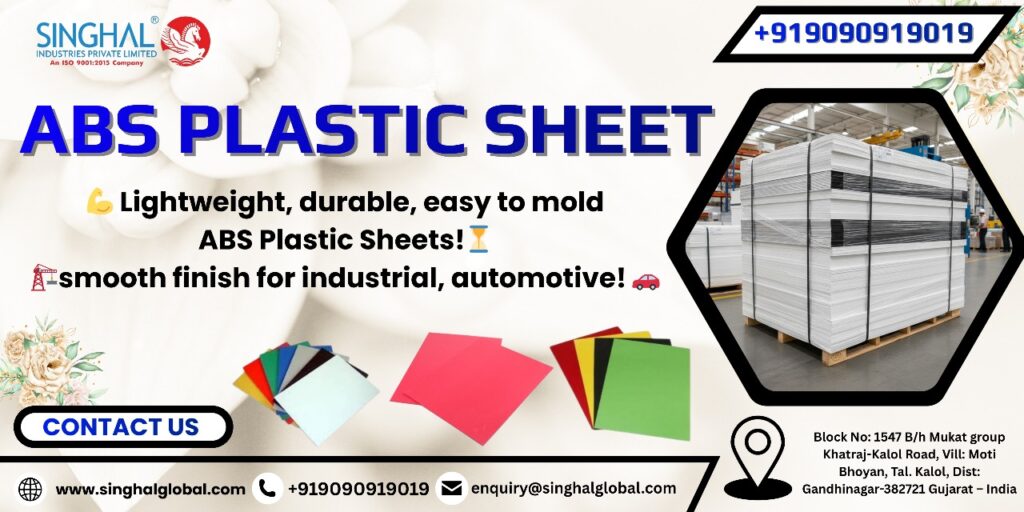
The future of manufacturing revolves around groundbreaking materials, and one of those revolutionary materials is none other than ABS plastic sheets. It’s not just a matter of putting one more plastic on the assembly line. ABS (Acrylonitrile Butadiene Styrene) is instrumental in bringing to life manufacturers’ loftiest dreams by designing quicker and making their products stronger than they ever imagined. Environmental improvement of technologies enabled by first-class ABS sheet manufacturers and plastic sheets manufacturers focusing on quality and adaptability has made it possible to use the ABS sheets in the manufacture of cars, custom toys, and durable medical devices.
The Unique Power of ABS Plastic Sheets
ABS plastic sheets have a trio of virtues: strength, flexibility, and attractiveness, and these are what make them almost magical. From a technical point of view, the blend of ABS involves acrylonitrile for the resistance against chemicals, butadiene for the toughness to be able to take an impact, and styrene for the shine and to make it more user-friendly. The outcome? Tough, light sheets which are able to take a blow and not break, can stand extreme temperatures, and even most of the kitchen chemicals if you happen to spill something on a gadget; they don’t let it damage.
However, this is only part of the tale. The reason for ABS plastics’ low melting point is that, unlike some that are very hard or brittle, it opens a path for innovative injection molding and 3D printing used by manufacturers for making on-demand detailed car parts, tool housings, or prototypes. Its shining, which is somewhat like “new car shine,” helps the stuff become a favorite for applications where looks are important, while its strength provides the product’s mechanical reliability when users are really pushing their limits.
Real-Life Applications: ABS in Every Corner
The use of ABS sheets in fabrication is not limited just to the most obvious areas. The following list shows the places where you can find these multipurpose plastic sheets:
- Automotive interiors and exteriors: Dashboard panels, bumper covers, steering wheel trim, and body parts all become more impact-resistant and lighter with the help of these materials.
- Medical devices: The rapid development of custom-fit prosthetics, equipment housings, and surgical guides where safety and sterilization are of utmost importance.
- Electronics: ABS is the material of choice for the device housings because of its low electrical conductivity and high surface quality.
- Construction and architecture: Apart from pipes and fittings, wall outlets made of ABS sheets resist rust and stay dependable in both hot and cold weather.
Picture yourself working in an auto plant in Detroit, where the vibration from the machines constantly loosened the dashboards of the old models. The annoyance was eliminated by the change to ABS. One machinist humorously said, “My coffee cup went through a fender test and came out intact, so I guess I owe ABS a thank you note!”
Sustainability, Efficiency, and the Circular Economy
ABS is known to be a sensible choice, but recent trends are pointing to its sustainability. Besides that, many Plastic sheets manufacturers nowadays have some recycled ABS offerings, hence lessening waste with recyclable materials that are still efficient. The transition to bio-based ABS is gaining momentum, especially in the luxury sectors such as electronics, propelled by consumers’ preference for environmentally friendly alternatives.
Pretty cool, isn’t it? The concept that a door panel of an old bus could get a second life as a sleek component in a latest smartphone. Leading exporters and ABS sheets manufacturers in Asia and Europe are reaping the benefits of these changes and are moving towards a circular economy whereby items that cannot be landfilled can find a new life on the production line.
Industry Trends and Innovations: Tomorrow’s ABS
What are the future plans for ABS sheets manufacturers? Imagine smart production with Industry 4.0—machines doing the assembling, a system always checking the quality, and IoT sensors telling the properties of the material for every sheet made. The demand is rising in Southeast Asia, Latin America, and North America, where urbanization and the need for more infrastructure are the main drivers of innovation.
While manufacturers were previously only expected to provide simple components, they are now customizing the grades to meet specific requirements – for example, fire-resistant ABS for electronic devices, UV-stabilized sheets for outdoor signs, or flexible panels for next-generation vehicles.
Moreover, the truth is that no one in the sector is fantasizing about a slowdown. The worldwide market is estimated to almost double from USD 2.4 billion in 2023 to USD 4.1 billion by 2032, with innovation being the main factor behind the growth.
Painting and Printing on ABS Sheets
One of the most common questions from designers and DIY enthusiasts is: “Is it possible to paint or print on ABS plastic sheets?” Certainly! ABS sheets are receptive to painting and printing, but to achieve that, one must properly prepare the surface, e.g., by cleaning and sanding, and then apply a suitable plastic primer, which helps the paint to adhere for a longer period. Whether your goal is a shiny promotional sign, a printed logo, or simply changing the color of a tool handle, ABS will cooperate, but you have to give it a little care during the process.
Most other plastics are not as versatile. Sometimes regular car paint will not work unless it is plastic-specific, but with the right primer, even hard enamel or acrylic paints will bind well. A signmaker that I know uses ABS outdoors for campaigns and says, “It’s very friendly to paint – even when I’m rushing and in panic because of the deadline!”
3D Printing With ABS Sheets
Absolutely, ABS is a preferred choice for 3D printers using FDM and SLA technologies due to its relatively low melting point and good thermal stability. The scene is filled with engineers printing everything from quick models to real operational parts – think of drone covers, specially designed jigs, or even LEGO bricks (yes, those as well).
Yet, 3D printing with ABS is a bit tricky and demands the material to be handled carefully. It occasionally warps or detaches from the printing surface, thus, exact temperature setting, good adhesion methods, and the right environmental conditions are necessary. Nevertheless, for both the maker community and the professional market, the opportunity to turn a simple ABS sheet into a masterpiece is simply priceless.
A certain engineer at a maker space once said: “With ABS, I can create custom brackets throughout the night. Just with a little acetone, the finish becomes so nice that the boss is easily fooled into thinking it’s made by a machine.”
Global Leaders and Exporters: Who Sets the Pace?
Efficient global trade and supply are of utmost importance for ABS sheet manufacturers. So, which country is the biggest exporter of ABS sheets? China is the leader in the area by a huge margin and has most of the market share–more than 80% of the whole ABS export shipments are from the region due to its extensive manufacturing infrastructure. Besides, Brazil is also quite close to the top as the leading exporter of ABS plastic sheets in terms of volume. Such a dominance means that the majority of global buyers get their bulk ABS from these countries to guarantee both reliability and cost-effectiveness.
Conclusion
To sum up, ABS plastic sheets are not just breaking but building new grounds for the future of manufacturing with the help of innovative ABS sheet manufacturers and plastic sheets manufacturer leaders whose creativity seems as boundless as a child’s imagination with a box of building blocks. Are you looking for reliability, creativity, and sustainability, all in one material? Go for ABS. But remember, even the best plastic needs a smart human to create something memorable.
Frequently Asked Questions (FAQ)
Q1. What are the main properties of ABS sheets?
ABS sheets are known for their excellent impact resistance, toughness, thermal stability, chemical resistance, glossy finish, and they are lightweight yet rigid—making them perfect for use in industries like automotive and electronics or even for the fabrication of medical devices.
Q2. Are ABS plastic sheets paintable or printable?
Yes, ABS plastics sheets can be painted and printed on if their surfaces are cleaned, sanded, and primed. Almost any type of paint or printing ink will adhere properly if the correct primer is used, thus even auto paint can be applied after preparation.
Q3. Can ABS sheets be exposed to the weather?
For sure, ABS sheets are weather-resistant materials and, thus, are a first choice for outdoor signage and displays. However, it is advisable to use UV-stabilized or acrylic-capped ones and ensure that the installation is of good quality and maintenance is regular.
Q4. Can ABS sheets be used for 3D printing?
Yes, ABS sheets are one of the most popular 3D printing materials due to their great properties of durability, flexibility, and heat resistance. They can be machined, thermoformed, and used as filament by hobbyists and professionals, but some caution is required to prevent warping.
Q5. Who is the largest exporter of ABS sheets?
Singhal indutries is the main exporter of ABS sheets, accounting for more than 80% of the world’s exports. Besides, Brazil is also a substantial contributor in terms of the volume of exports.