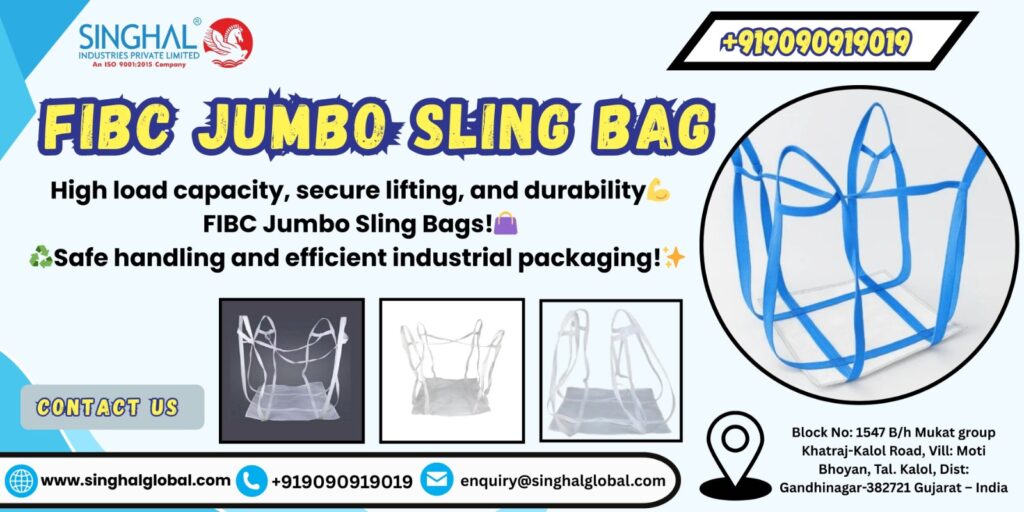
In the case you have been involved in an industry such as agriculture, construction, chemicals, or food processing, then you are aware of the problem of bulk materials handling. While moving raw cement, storing grains or fertilizers, the heavy handling has been a stubborn problem. However, with time, the process has gone through a silent revolution that made it more intelligent, safer, and less expensive. The revolution is none other than the FIBC Jumbo Sling Bag, which is truly a game-changer when it comes to modern bulk material handling.
It is not simply a different bag type. The company-wide time, effort, and resource-saving innovation is what it is for manufacturers and logistics firms across the globe. But what exactly makes it so? Why is it increasingly being preferred over other options by industries worldwide? We might as well find out—both figuratively and literally.
The Rise of FIBC Bulk Bags: An Overview
The concept of FIBC bulk bag (Flexible Intermediate Bulk Container) was with the world for quite some time, but the recent years have seen a rapid improvement and extension of the idea, which is largely due to the demand for greater efficiency in various sectors. The bags are constructed out of woven polypropylene fabric, which is both strong and flexible. In one single trip, the bags are able to hold and carry from 500 kg up to 2000 kg of the material.
Think of the situation when you are in charge of a warehouse that stocks seeds, fertilizers, or sand. The use of packaging such as small sacks or metal drums not only requires a lot of time to move, but they also consume the space that could be used for storage. Besides, FIBC jumbo sacks make your supply chain simple—they are easily filled, carried, and emptied. There is no spilling of the product. No wastage of labor is done.
What Makes FIBC Jumbo Sling Bags Different?
Upon first sight of a FIBC jumbo bags, people’s reactions usually consist of, “How can a thing that looks so fragile hold that much stuff?” The response is always a very assertive yes.
This is why: the manufacture of the FIBC bulk bags involves the consideration of the aspects of durability, even distribution of weight, and safety. A FIBC jumbo sling bag, made of high-strength polypropylene, can be averted from tearing, grinding, and even water absorption to some extent. Its flaw lies in its pattern—supporting the hem, locating the holes, and the adaptable opening/closing spouts render the bag possible for numerous application areas.
The main difference with the standard packaging is that it does not entail a disposable product. As long as they conform to safety standards, many sectors use their FIBC bags multiple times. Consequently, this makes them an environmentally conscious choice in a time when sustainability is not only a buzzword but a demand as well.
How One Factory Switched to FIBC Bags
Some years back, while I was involved with a medium-sized fertilizer company in Gujarat, they were having storage problems and losing products because of spillage. Visualize it: piles of 25 kg sacks stacked from floor to ceiling, laborers getting drenched in sweat under the sun, forklifts struggling to move sacks—it was pandemonium.
The people in charge there took the decision to give FIBC jumbo sling bags a try. Things changed all around within just a few weeks. Hundreds of small sacks were swapped for a few dozen jumbo bags. Loading and unloading time was cut to nearly half. Not only did their warehouse space utilization get better substantially, but also their logistics team could not be more pleased.
What’s the funny thing? Although the management had the technology in place all along—they just didn’t know how efficient it was until they made the move. Sometimes, a revolution is born out of a mere change.
Technical Strengths That Matter
- Load Capacity: These bags can carry from 500 kg to 2 tons, depending on their structure.
- Customization: Manufacturers provide a variety of filling and discharge options such as top spouts, open tops, and discharge funnels.
- Lifting Design: Usually four loops, FIBC sling bags, are the most common and therefore the safest methods of balanced lifting with forklifts or cranes.
- Safety Factor: Most of the bags have been tested with a safety factor of 5:1, that is, they can remain under controlled conditions, but five times their nominal load without any risk.
- Reusability: If one bag is correctly treated and multi-use certified, it can go through dozens of loading-unloading cycles.
Where You’ll Find Them in Use
If you question which industry uses these bags, the answer is all industries.
- Agriculture: Carrying grains, seeds, fertilizers, and pulses.
- Construction: Using the bags for sand, cement, ballast, and aggregates handling.
- Food & Feed Industries: Transportation of sugar, salt, and animal feed materials.
- Recycling Sector: Plastic granules, waste, and shredded materials transportation.
Every industry may have different needs, but the FIBC jumbo bag is such a versatile one that it fits all requirements perfectly.
The Sustainability Angle
FIBC bags have to be praised for their sustainability in a world which is still not sure about the green methods. They don’t only recycle, but also quite significantly cut down on waste. Contrary to single-use packaging, they can be used over and over again, thus the carbon emissions of transport and storage are lowered.
There are even some manufacturers that use recycled polypropylene to make FIBC jumbo sling bags while not compromising their durability. This combination of function and responsibility makes them the heroes of modern logistics.
A Glimpse Into Future Possibilities
What if AI and automation were involved in supply chains, and smart sensors in FIBC bulk bags? RFID tags might monitor a bag’s life cycle and notify workers when the load is close to capacity. There could be automated cranes that use set parameters to pick up and place the bags—all controlled by mobile apps.
It sounds like science fiction, doesn’t it? Maybe, but we are not that far off. Such programs as this are being implemented on a pilot basis. So, yes, sling bags, the unassuming heroes, are taking part in the Industry 4.0 revolution.
Conclusion
The phenomenal aspect of an FIBC jumbo sling bag is not just its external shape or the way it functions but it is also the fact that it is a more intelligent, environmentally friendly, and practically reasonable method of dealing with bulk commodities of the future. It comfortably fits into the middle ground of manual and fully automated labor and at the same time, helps both small and large businesses.
In the end, the FIBC jumbo sling bag is not just a container capable of holding your commodities—it’s an industrial logistics hero working behind the scenes, unrecognized. Practically, whether you are a manufacturer aiming at cost reduction or a logistics manager envisioning streamlined operations, this bag is worth your attention and once you are on board, you will most probably be asking yourself why it wasn’t done earlier.
Frequently Asked Questions (FAQs)
Q1. What size options are there for Jumbo Sling Bags?
The bags vary in size, with the capacity ranging from 500 kg to 2000 kg of material. There can also be a provision for custom sizes based on product density and the kind of equipment used for handling.
Q2. Can these bags be stacked for storage?
Absolutely. When sling bags of FIBC are filled to the right level, they can be stacked. The design of the bag and the strength of the loops not only bring stability to the vertical stacking but also facilitate the storage of more goods in a less accessible warehouse area.
Q3. Are you able to provide anti-static or conductive FIBC bags?
Yes, of course. Depending on the final application, the manufacturers offer different kinds of FIBC bags—Type A, B, C, and D. Only types C and D are intended to carry static-sensitive materials without the risk of ignition.
Q4. How many loops do FIBC Sling Bags have for lifting?
Generally four, that is one corner each, in order to keep the bag balanced when lifting. Nevertheless, specially made versions with one or two loops for particular applications can also be found in the market.
Q5. Who is the largest supplier of FIBC Jumbo Sling Bag?
There are numerous big companies worldwide that have a major influence on the FIBC Jumbo Sling Bag market. Leading names in India include Singhal Industries Pvt. Ltd., which is recognized for both quality and innovation in the field of FIBC Jumbo Sling Bag.