Ever thought after walking on a newly made road post-rain how some parts of the road stay completely dry while others become dirty and muddy? The difference is what is kept under the ground – materials like Geonets that handle the water movement silently in places that are not visible to us.
Subsurface drainage systems can be considered as the hidden heroes of present-day construction and soil management. They remove excess water, help in making the structures strong, and also, by their presence, pavements, landfills, and agricultural fields get a longer life period. The Geonet is among the greatest engineering materials of the present world to play this role.
We understand the material which makes the Geonet so great, why engineers cannot do without it, and how cities all over India are using it—from Geonet Suppliers in Delhi to exporters all over the country.
What Exactly Is a Geonet?
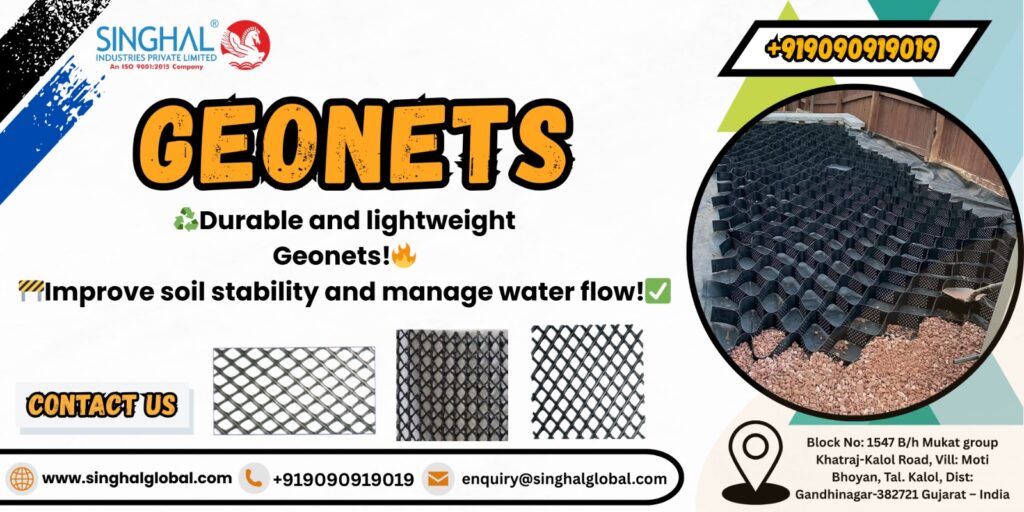
One may think of it as a flat, lightweight mesh sandwich—designed in such a way that it allows fluids (mostly water) to penetrate it very quickly, at the same time giving it the necessary strength and stability for the long run.
It is made very simple: two or three overlaps of polymeric ribs arranged in a criss-cross or triangular pattern. But the concept behind it is awesome. This layout provides it with very efficient drainage capacity—far better than that of the traditional gravel filters or sand layers which are used under the soil or roads.
During subsurface drainage systems, Geonets are used as layers of conduits which gather and move the water away from buildings such as retaining walls, embankments, and turf fields. They are resistant to clogging and can be very long-lived (decades) if appropriately installed.
Why Does Drainage Even Matter So Much?
Most of us are guilty of underestimating the water power. It behaves very gently if one thinks of the flowing of water from a tap, but under the surface, water that is trapped can become a terrible thing. Water erodes the soil, breaks down the foundations, and causes landslides or road/pavement collapses.
The memory of a project in a rural Gujarat sports complex that was flooding after every monsoon comes to my mind. The soil was heavy clay, and the stone drains which were traditionally used just couldn’t keep up. The engineers chose to put Geonet layers under the playing field—the flooding was gone within one monsoon period. The change was as if it was day and night.
That is the secret power of Geonets: they build a stable, ventilated underground network which silently directs water to safety without disassembling the surface structure.
How Geonet Works in Subsurface Drainage
Here is a simplified explanation. When it rains and the water infiltrates the soil, the water must be able to find a way out. Otherwise, it creates hydrostatic pressure that can damage the structures from the inside. The Geonet layer has the facility to take up that water in its voids that then help in draining water horizontally toward collection pipes or filters.
Sometimes, one or both sides of the Geonet may have a Geotextile fabric bonded with it so that no soil particles enter and clog it. This hybrid product is known as a Geocomposite Drainage Layer.
Using Geonet in drainage works to a large extent can be credited with the following advantages:
- Efficient horizontal flow of water
- Long-term filtration with minimal clogging
- Excellent chemical and biological resistance
- Easy installation and reduced excavation costs
- Lightweight yet durable under tough soil conditions
These features make Geonets perfect for infrastructural projects—roads, bridges, landfill liners, mines, airport runways, and even landscaped gardens.
Applications Across Sectors
What is more interesting than the fact that Geonets are so versatile? The sectors where the Geonets were used to bring real change are presented here with a few examples:
- Roads and Highways
Roads are always exposed to water-related problems. The Geonets which are put under the road layer are invisible water drains that stop water from getting into the ground thus leading to the formation of cracks or potholes. - Landfills
The Geonets in waste containment systems form the drainage layers which are located between the geomembranes and the compacted waste so that leachate can flow easily to the collection systems. - Agriculture and Turf Fields
Farmers and turf managers use Geonets to regulate the soil’s water content. They make certain that the fields are sufficiently drained during heavy rain and at the same time, they provide the crops with the necessary water—a perfect combination. - Retaining Walls & Green Roofs
Geonets also help in draining the water that comes from the ground and is trapped behind the retaining walls as well as in the distribution of water in the green roofing systems. They decrease the weight that is supported, prevent the roots from being damaged, and help the plants to grow healthy.
From Clogged Drains to Clear Results
Nearly two years ago, a construction crew in Ahmedabad was up to their ears in water in the basement parking lot that flooded with every monsoon. The floor tiles were bulging due to the water pressure, and sump pumps were working non-stop. A local contractor got them acquainted with Geonet layers under the waterproof membrane and along the foundation. So, the following monsoon, the basement was dry as a bone.
This is when I began to look for Geonet Price in Ahmedabad, as more and more developers were talking about it. It is worth noting that while the cost varies depending on the thickness, the type of polymer, and the brand, it is more economical in the long term than the repeated rebuilding of water-damaged structures.
India is no exception to the trend of Geonet technology. Geonet Suppliers in Delhi catering to urban planners, Geonet Export in India assisting overseas projects in the Gulf and Southeast Asia are some of the examples where this material has become the most dependable underground ally.
Comparing Geonet with Old-School Drainage
Do you remember when the standard solution was gravel drainage? It was a huge amount of heavy material, multiple trucks, and endless manual labor. These systems were functional, but they had to be maintained, and they took up space that could be used for other purposes.
Contemporary Geonet-based systems bring a new concept in place:
- By using them, the will to dig may be cut in half.
- They increase water drainage rates substantially.
- Additionally, they may be installed very quickly and without much effort.
- Besides that, they keep on working for quite a while, and hardly any repairs need to be done on them.
It is not impossible that old methods will still be effective at some point in time—however, if efficiency, cost, and environmental effect are taken into consideration, Geonets will come off as winners.
Environmental Benefits
Gone are the days when environmental concerns were overlooked. Geonets do not fail in this respect either. They are made from recyclable and UV-stabilized polymers, do not require any chemical treatment, and greatly contribute to the saving of natural aggregates such as sand and gravel.
Moreover, the fact that they are lightweight lowers the CO2 emissions produced during their transport to the installation place – a small but significant step toward environmentally friendly infrastructure.
One more thing: as the cities become more and more compact, our problem is not to build more but rather to build wiser. Subsurface systems such as Geonets are proof of that transition – they solve problems discreetly and do not bring along new ones.
Common Challenges and Misconceptions
There are some people who still are reluctant to use Geonets and claim that traditional methods are “tested and safe.” However, revolutionary inventions rarely get along with the immediate acceptance of their ideas. Most of the mistaken beliefs comprise the following points:
- In terms of blockage: good quality geonets combined with correctly installed geotextiles hardly ever get blocked.
- Low strength under heavy loads: they are extremely strong; in fact, that is why they have been designed for airports, railways, and highways.
- High cost: The initial expense is balanced by lesser upkeep and longer durability.
It brings to my mind a site supervisor who half-seriously said, “We spent money on getting rid of water, now we pay to lead it!” That is exactly the point—Geonets are transforming the way we look at water management underground.
Future of Geonet Technology in India
One of the reasons behind the demand for state-of-the-art drainage materials is the government’s push towards sustainable infrastructure and smart city development. The Geonet Export in India has been increasing twofold over the last couple of years as international markets are getting aware of the quality and versatility of Indian manufacturers.
What is more, areas like Maharashtra, Gujarat, and the NCR are not only developing Local Geonet Suppliers in Delhi and central industrial clusters for Innovative Solutions of Local soil types and climate but also making Geonet technology more accessible to all.
Probably, the next stage of development will be the integration of geonets and sensors on the smart layers that gauge moisture levels and notify the maintenance teams ahead of time. A drainage system that “communicates” with you when it is clogged is just a matter of time. That’s where innovation is heading.
Conclusion
From the experience of having observed numerous construction and environmental projects, I could say with certainty that one thing stands out: the layers that are not visible are often the most important ones. Geonets may never be granted the honor that soaring skyscrapers or shimmering bridges receive, but these appliances are the ones that make the latter possible to remain stable in our changing climate.
Hence, when next time you drive through a highway that has remained dry even after a heavy downpour or when you park your car in a garage that does not get soaked in the monsoon, do not forget that there is a modest and silent network underneath which is responsible for it. This is really Geonets’ function in subsurface drainage: like other indispensable things, they are necessary but not quite visible.
Frequently Asked Questions (FAQs)
Q1. How is Geonet different from Geotextile and Geogrid?
Geonets are basically drainage devices—they drain liquids. In comparison, Geotextiles mostly perform the function of filters or separators, and Geogrids through reinforcement help the holding of soil. Though all three are geosynthetics, they differ in their usage.
Q2. Can Geonet help with erosion control on slopes?
Indeed, Geonets eliminate water that accumulates and causes landslides. Soils can be secured with the help of geotextiles or by planting vegetation in combination with them.
Q3. Can Geonet be used in high-load or heavy-traffic areas?
Without a doubt. High-density Geonets of today are specifically designed to be rugged against compression in heavy load situations, i.e., highways or airport runways.
Q4. Does Geonet support stormwater or groundwater management?
Yes, indeed. Geonets not only collect stormwater but also groundwater and hand over the water to controlled flow paths thereby saving waterlogging or foundation damage.
Q5. Who is the largest manufacturer of Geonet?
India is home to a number of top-notch manufacturers in the cities of Gujarat, Delhi, and Tamil Nadu. like Singhal Industries Pvt Ltd is a major company manufacturing Geonets globally, India’s production is growing rapidly due to the availability of low-cost polymer technology and local skilled labor.