In the present crowded market, being noticed is more essential than ever. For businesses shipping bulk items or retail companies that handle huge inventories, packaging is not only about function, but also an opportunity to brand. This is where the printed HDPE bags shine. They’re sturdy, practical, and can be used as a blank canvas for your imaginative logos and marketing messages. They can be used to store agricultural products such as grains, cement, and fertilizer, or serve for retail transport and retail carriers. Printed HDPE bags are more than just “carry.” Let’s unpack the world of printed HDPE bags, look into the production process in Hyderabad, and address any questions you have about the multi-purpose bags.
Why Printed HDPE Bags are Everywhere
If you walk into a store, supermarket, or grain godown, you’ll see the slightly crinkly, sturdy bags that are often adorned with striking colors and logos of brands. They’re HDPE (High-Density Polyethylene) bags. What is it that makes them the most sought-after in all sectors?
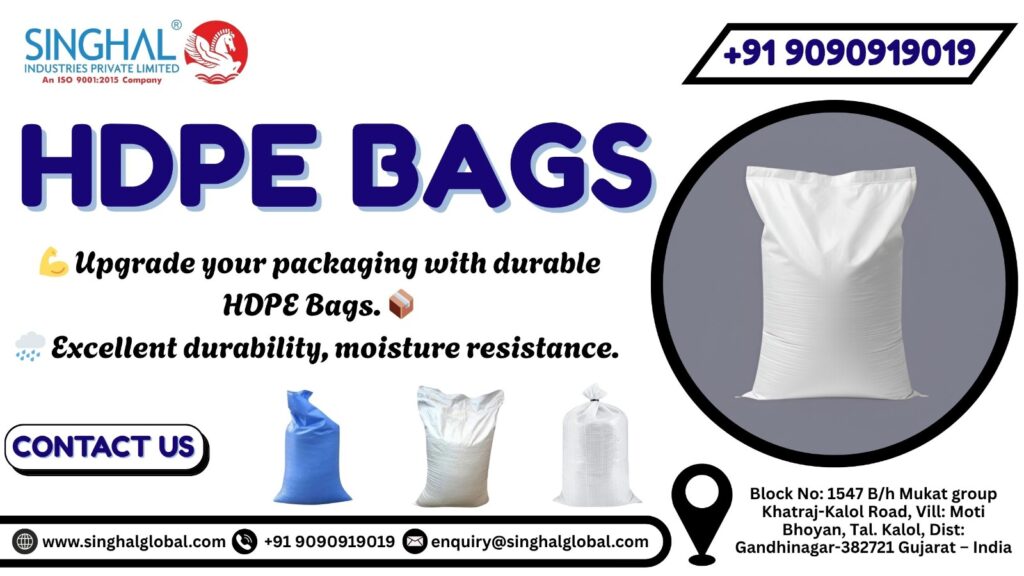
The toughness of HDPE bags is significantly more durable than standard plastic bags. This is why you can find bags that can carry up to 50 kg of wheat, rice, fertilizer, or washing powder without breaking a sweat.
The ability to resist moisture and weather is another advantage. Do you want to keep your grains dry during the monsoon? These bags are for you. HDPE is extremely impervious to water, so even when storage conditions aren’t optimal, what’s inside is protected.
The printing potential of HDPE bags is similar to an artist’s canvas. With the correct method and ink, brands can print everything from striking logos of their companies to crucial handling instructions as well as batch codes. This helps increase the recognition of their brand and gives vital information to buyers and transporters.
From tiny shopping bags to huge HDPE bags that weigh up to 50 kg, there’s a size that’s right for any use.
Where Do These Bags Come From? (Manufacturer Insights)
India has been embracing HDPE packaging in an enormous manner, but HDPE bag producers in Hyderabad have created a distinct niche. Hyderabad’s industrial area is brimming with businesses that make thousands of bags to be used in industry, agriculture, and retail every month. A lot of them offer custom-designed color options, printed graphics, and even accept the artwork of customers.
Contacting a Hdpe bags manufacturers in hyderabad could mean:
- Quick shipment throughout South and Central India
- Fully customizable, down to bag color or thickness. You can even change the texture
- Cost-effectiveness due to the proximity of supply chains and well-established supply chains
A reputable manufacturer will pay attention to a specific business’s needs. Are you looking for ultra-strong HDPE bags of 50 kg to export rice and also prefer environmentally friendly inks for printing? A reputable manufacturer can meet your needs with pride in each order’s minor modifications to the design or practical requirements.
Sizes, Thickness, and Customization–A Quick Guide
One size definitely doesn’t suit everyone. Let’s take a look at the typical business questions:
Typical Bag Sizes
- Small (1-5 kg): Ideal for retail gifting, small packaging for products.
- Medium (10-25 kg): Popular for produce, animal feed, and chemicals.
- Large (35-50 kg): Used in construction, agriculture, and large-item retail.
“HDPE bags 50 kg” size is a reliable item that is seen everywhere from wholesale grocery to distribution of industrial chemicals.
Thickness Matters
The typical thickness is between 40-150 microns or greater, based on the intended use of the bag. Bags that can hold 50 kg of weight require more density and weave than light retail bags to avoid tearing and to ensure security. Manufacturers usually recommend the right thickness based on the items you intend to store in the bag and how the bags will be stored or handled. It’s never a bad idea to ask for a test first. Sometimes, what appears to be fine in concept doesn’t work in real-world warehouses.
Real-Life Utility Meets Branding
The first impression of a bag isn’t formed by the contents inside the bag but rather by its appearance. If a customer sees a clean, colorful, bright, and logo-printed bag that is stacked in a warehouse, the message is obvious: professionalism, concern, and confidence. It’s important, regardless of whether the buyer is a distributor or any other company.
An importer of wheat from Hyderabad said, “Earlier, I used to carry my goods in simple white bags. With a new, green logo ‘GharKaAnaaj’ printed on each bag, customers immediately recognize us. Even bags that are not labeled are not noticed.” These stories aren’t uncommon. All across India, enhanced marketing on something as simple as a bag leaves lasting impressions that can increase the likelihood of repeat business.
Opinions, Contradictions, and the Human Side
There are some issues, and there are times when customers make complaints such as “Bags tore in the rain!” or “Printing faded too quickly.” Every issue is an opportunity for learning, both for sellers and Hdpe bags manufacturers. Many believe that the jute sack of old “breathes better” than HDPE, which helps keep potatoes and onions from turning brown. Some claim that HDPE is lighter and less susceptible to insects, thereby overcoming the defect. These kinds of debates are not uncommon on local market shelves.
It’s no secret that there is a growing connection between brand and daily utility. Nowadays, even small-scale millers or farmers want their names on the shipping documents to show their pride, credibility, and a little confidence in the tumult that is Indian markets. In addition, Hyderabad’s manufacturing industry is always adapting to the latest printing techniques (multi-color and digital printing, as well as biodegradable inks). The possibilities are growing.
Conclusion
Admittedly, to most businesses, the issue of packaging may appear tedious and not their problem until they run into a nightmare. The leaking bags, the labels that do not fit, or spoilt bags would spell doom in terms of a bad reputation and loss of sales. That is why an increasing number of companies start to see potential in printed HDPE bags. They do not just concern utility and safety, they are about leaving a permanent impression and a mark, literally.
In case you find yourself in front of a stack of shining bags with logos on the rear of a shop, consider the following: behind each bag is a compelling tale of how it could have been to be powerful in identity, to be innovative, to have industriousness. In the case of the bags, the team is likely to have a group of avid fans in Hyderabad that is trying to incorporate branding and functionality one bag of printed HDPE at a time.
Frequently Asked Questions (FAQ)
Q1. What is the main difference between HDPE bags and LDPE bags?
HDPE (High-Density Polyethylene) bags are more durable, rigid, and can withstand greater weights than LDPE (Low-Density Polyethylene) bags, which are lighter and more flexible. They are preferred when stretch or clarity is required. For instance, grocery store bags are typically LDPE, as are heavy-duty cement bags, while HDPE bags for rice that weigh 50 kg are usually HDPE.
Q2. What are the sizes of HDPE bags?
Between a few centimeters to massive 50 kg bags. The most commonly used sizes are 1 kilogram, 5 kilograms, 10 kilograms, 25 kilograms, or 50 kilograms. Manufacturers can customize sizes of bags to satisfy the needs of customers.
Q3. What is the thickness of standard HDPE bags?
The standard thickness of HDPE bags ranges from around 40 micrometers, which is suitable for light retail usage, up to 150 micrometers or greater for large agricultural or industrial bags, such as the HDPE bags 50 kg version. Always consult your HDPE bags manufacturer to determine the best measurement.
Q4. Can one use HDPE bags to store the freezing?
Absolutely. HDPE does not lose its structure at very low temperatures and this feature makes it the best material to be stored in the freezers without disintegration or degradation. In fact, many industrial freezer bags are made out of HDPE or mixed.
Q5. Who is the largest Suppliers of HDPE bags ?
There are numerous large firms in the world but in India, there are large scale suppliers that are located in Gujarat, Maharashtra and Andhra Pradesh. Hyderabad has few HDPE bag producers that have gained national popularity because of their attention to the quality of products, fast turnaround rate, and variety of customization.