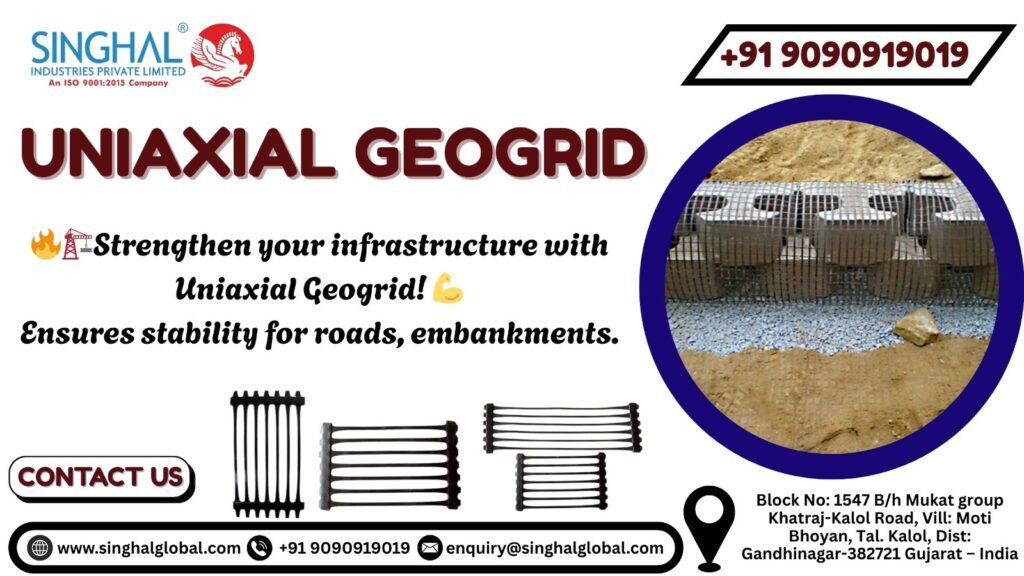
In the case of the strengthening of soil and the raising of structure stability, HDPE uniaxial geogrid is a typical example of new engineering technology. It is a specially engineered geosynthetic fabric, which serves as a necessary reinforcement tool in civil engineering, thus contributing to the less wear and better performance of roads, slopes, retaining walls, and foundations. Although it is a technical product, the main idea, which is also its strength, is quite simple — the product is aimed at one direction of tension and support of soil and structures are done indirectly.
What Is HDPE Uniaxial Geogrid?
HDPE uniaxial geogrid is fabricated from high-density polyethylene, which is a robust, long-lasting plastic material that is resistant to weather and is strong. In comparison with biaxial geogrids that provide strength in two directions, uniaxial geogrids offer very high tensile strength primarily in one direction (along the roll length).
With a uniaxial concept, the product is perfect for the reinforcement of the soil in the case of one-directional tension, e.g., that of retaining walls or steep slopes. Besides that, the grid being open can also be used as soil particles’ interlock which, in turn, leads to the formation of a strong mechanical bond capable of stabilizing the soil layers.
Key Applications of Uniaxial Geogrid
Uniaxial geogrids have become the Swiss Army knives of geotechnical engineering, being put to work in a mix of harsh environments:
- Retaining walls: They optimize soil reinforcement behind retaining walls, thus preventing soil slips and permitting higher wall elevations without extra mass.
- Road infrastructure: They are employed to strengthen subgrades and pavement layers, thus lowering the road wear and raising the service life.
- Slope stabilization: They are most suitable for slope bolstering initiatives that involve steep or unstable slopes, which happen to be the tensile force main sources acting downhill.
- Industrial sites and landfills: They play a role in the packaging of container yards, landfills bases, or industrial flooring, thus providing support for the heavyweight loads.
- Bridge abutments and foundations: Along with this, they aid in the strengthening and continuance of soil stability under conditions of loading that are long-term.
Consequently, the item is always very close to the core of a lot of other extremely vital places, playing the same kind of functions that refer to one primary direction of stress.
How Directionality Affects Reinforcement
The “uniaxial” characteristic is an essential one as it is directly linked to the principal rule of engineering: reinforcements work most efficiently when they are in line with actual stress patterns. The application of high tensile strength in only one direction is indicative that the geogrid is not wasting either material or money by reinforcing unnecessarily in less critical directions.
However, this fact also implies that the designers have to properly locate the grid on the site, thereby ensuring that it is parallel to the direction of the load that is anticipated. In case the position of the grid is wrong or the forces acting on the soil come from angles that were not expected, the performance will be affected.
Hence, this fluctuation gives rise to a paradox: great in strength and cost-efficient, uniaxial geogrids nevertheless need the intervention of a thoughtful designer and a careful installer, unlike the ones of biaxial type which cover two directions. Therefore, the question if the grid direction influences reinforcement performance may be answered affirmatively.
Ease of Handling and Onsite Installation
One major advantage of HDPE uniaxial geogrids is their usefulness. They are relatively good and pliable as compared to the traditional materials and thus they are less problematic when it comes to their transportation and handling at construction sites. The grids may be easily cut at the site by using snips or disc cutters and there is no need for issuing specialized tools or training.
Present work of this nature is usually facilitated by the ease which tends to keep the projects moving fast, provides labor savings, and thus rejects the occurrence of delays. However, although the process is quite simple, the workers on site should be aware that the grid must be properly tensioned so as to not let it be slack and also to achieve the maximum effectiveness. Incorrect installation may result in the lessening of acceptance of the reinforcement benefits.
Using Uniaxial Geogrids on Steep Slopes
Uniaxial geogrids specially serve the purpose of steep slope reinforcement. Their main feature of high tensile strength along the length is used to overcome soil movement that is downhill. Thus, when the use of the geogrids is appropriate, they not only stabilize the slopes, but also limit the erosion process and reduce the risk of landslides.
On the other hand, due to steepness, extra care is demanded in the process of installing these grids firmly and sometimes employ additional methods such as anchor or use of vegetation for slope stabilization. The geogrid is a potent tool but it is not a universal answer.
Who Are the Largest Manufacturers in India?
Many of the top-quality geogrid manufacturers with competitive prices are located in India. Singhal Industries can be considered as the most influential one among geogrid producers in India. The company is extremely focused on HDPE uniaxial geogrids with high tensile strength and long-lasting properties.
Besides that, they, on a whole, make geogrids accessible to all the infrastructure projects through their great supply chain and less expensive Geogrid price in India. The next big names to talk about are Geo Sys India and Tech Fab India that manufacture various kinds of geosynthetics for different civil engineering requirements. They mainly invest in cutting-edge production technology and strict quality management to ensure that all of their products meet global standards.
Conclusion
An HDPE uniaxial geogrid is a perfect example of advanced polymer engineering coming together with the practical needs of civil construction. It is their one-directional tensile strength, simple handling, and service life that make them a must for the majority of the projects. In return for these benefits, however, there should come a thoughtful design and the right installation. By opting for the best Geogrid manufacturers in India one can get quality products at reasonable prices, which is a great support for infrastructures that are safer and have a longer lifespan and are for the benefit of everyone.
Frequently Asked Questions (FAQs)
Q1. What are common applications of Uniaxial Geogrid?
Some uses of the grid include retaining walls, road and pavement subgrade reinforcement, slope stabilization, landfill and industrial site support, and bridge foundations. These are the main ones that utilize the uniaxial tensile strength of the grid for soil stabilization over time.
Q2. Does the grid direction affect reinforcement performance?
Yes, as tensile strength is only strong in one direction, the position of the grid in relation to soil stress is very important for maximum effect. If the alignment is wrong, the reinforcement will have less power.
Q3. Is Uniaxial Geogrid easy to cut and handle onsite?
Indeed, it is of a low weight and can be simply chopped using basic tools such as snips or disc cutters, the cutting process thus is quite fast and installation can carry on without the need for heavy machinery. Nevertheless, it is still a must that the best results come from correct tensioning.
Q4. Can Uniaxial Geogrid be used on steep slopes?
Yes, it is particularly ideal for slope steepness reinforcement through strong tensile resistance being provided along the slope face, however, installation should be done with care and, if necessary, additional stabilization can be used.
Q5. Who is the largest manufacturer of Uniaxial Geogrid?
Singhal Industries is a major player in India and worldwide and is known for creating high-quality HDPE uniaxial geogrids that can be used in heavy infrastructural projects.