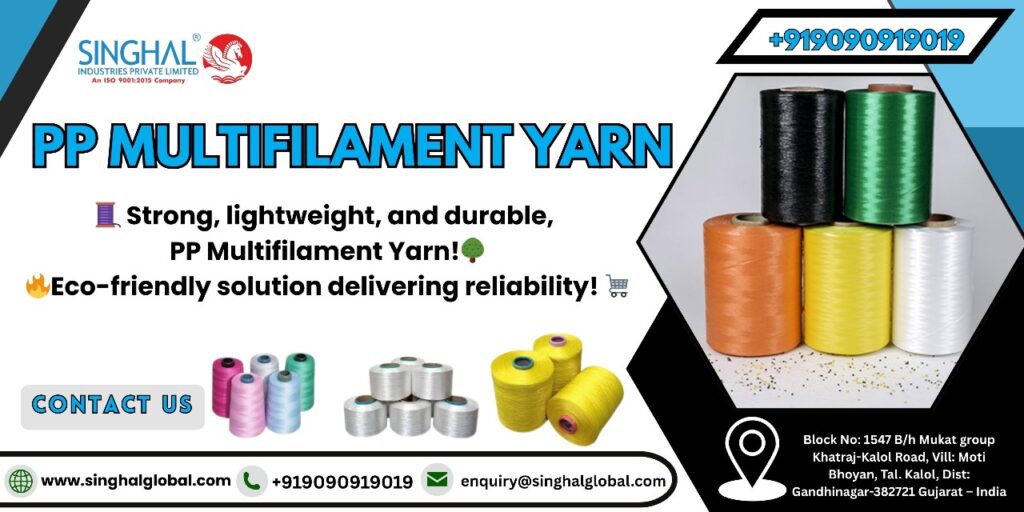
If we are talking about technological advancements in the packaging and textile industry, one product that isn’t a lot of news is the PP multifilament. It may not be a focus of attention like high-tech fabrics or fancy composites, but its use in a range of industries, from geotextiles to packaging, is anything but revolutionary. I remember going into a plant in Gujarat where workers were sewing FIBC bulk bags with the strong white yarn made of PP. The hum of the sewing machines that were running continuously, as well as the smell of the polymer process in the air, was a reminder of the way a “simple” yarn carries the power of global industries.
What exactly makes this yarn so high-performing? It is all in the technology in engineering, precision, and the ambition of each PP yarn maker who is committed to pushing the boundaries.
What is PP Multifilament Yarn?
In its essence, PP multifilament yarn are crafted of polypropylene, a thermoplastic polymer that is now one of the most flexible materials. This “multifilament” part means that instead of being one yarn, it is made up of numerous fine filaments that are strung together. This makes it have strong tensile strength, light characteristics, and long-lasting durability.
If steel is the basis in construction, PP multifilament yarn can be described as the core for modern-day industrial stitching as well as reinforcement. When it comes to tying up heavy-duty bags, creating fishing nets, or supporting geotextiles for road construction, this yarn plays an insignificant but effective function.
The Technology That Drives Performance
It is not only a question of luck when it comes to high-performance. It is the product of the mix of extrusion stretching, twisting, and stretching technology that make PP yarn as unique as it is.
Extrusion of Polypropylene
This starts by melting of polypropylene grains at predetermined temperatures. Even the tiniest difference in melting can change the quality of the yarn and this is a must. I have talked to one of the technicians; he said that, when the melt is not right, the yarn breaks too frequently, and production is a headache.
Filament Formation
Spinnerets (small nozzles) are used to extrude the molten polymer into a range of fine filaments. This is where precision engineering will be critical. Homogenous filaments guarantee the homogeneity of strength.
Stretching and Orientation
They are pulled to align the polymer chains and raise the tensile strength. In the absence of such elongation process, yarns would be weak and soft.
Twisting and Intermingling
In order to make the yarn usable for industrial use, the filaments are twisting and mixed. The twisting increases the bulk and grip and makes the yarn suitable to stitch tough materials like bulk bags and tarpaulins.
Where PP Multifilament Yarn Outshines Others
- Strength vs. Weight: It is extremely light but incredibly robust.
- Water Resistance: In contrast to cotton, it isn’t able to absorb water, which makes it perfect for marine and outdoor applications.
- Cost Efficiency: Polypropylene is less expensive to manufacture than other polymers.
Here’s a fascinating link: many PP yarn producers also make Polyethylene sheets for construction. Although both materials are employed in different ways, they share a similar polymer base. Polyethylene sheets strengthen concrete and protect against water damage, while PP multifilament yarn stitches the bags that hold concrete or sand. Different applications, the same science.
Real-Life Applications: From Roads to Ropes
I’ve seen it on fishing ports, construction sites as well as in household textiles. Let me tell you some real-world examples.
- Road Construction in Maharashtra engineers employed geotextiles woven with PP yarn in a brand new highway construction project. The yarn’s strength was able to stabilize soil and stop erosion.
- Fishing Industry In Kerala the fishermen rely on PP yarn to create nets that are able to withstand saltwater. A fisherman I spoke to said “Cotton nets rot in no time, but this yarn gives us seasons of use.”
- FIBC Bags: As we mentioned earlier, heavy-duty bulk bags that transport chemicals, grains, and fertilizers are stitched using PP yarn. Without it, the bags would be destroyed during transport.
The Human Side of Technology
We tend to discuss technology as cold: extrusion lines, number of deniers, tensile strength. Though, behind each spool of PP multi filament yarn, there are people, engineers and companies which rely on its stability. Consider a laborer on the job depositing his faith in a bag of cement more than twice its usual size, filled with PP yarn or a farmer who can tie his harvest package before going to the market. When the yarn does not show, then it is not only a matter of losing money, but also losing anxiousness about money and wasting time. That is why the finest PP yarn manufacturer do not cut corners. They know they are not selling yarn, but quality.
Conclusion
The story of PP multifilament yarn narrates about a silent genius. It is neither as smooth as cotton, nor as glamorous as silk but it is a power that binds businesses together. It is found in fishing nets, in highways, in polyethylene sheets on which a building is constructed, in bags of bulk.
The next time you pick up a strong bag that has been sewn well or a net containing a full day’s haul, stop and consider.
Frequently Asked Questions (FAQ)
Q1. What industries make use of PP Multifilament Yarn?
It’s utilized in the packaging industry (stitching FIBC and woven bags), fishing (nets and ropes), agriculture (bundling), construction (geotextiles), and furniture for homes.
Q2. Do you think it is safe for food contact applications?
Yes, the food-grade PP yarns are safe and frequently employed in packaging material for sugar, grains, and flour. But, make sure to verify the appropriate certifications prior to using it in conjunction with food products.
Q3. Can multifilament yarn made of PP be tailored to the strength of tensile?
Absolutely. Manufacturers can vary the degree of twist, number of filaments and denier to suit the particular needs of tensile strength.
Q4. Is PP yarn suitable for stitching FIBC bags?
It is indeed one of the most commonly used yarn due to its longevity, strength and also its affordability.
Q5. Who is the largest exporter PP Multifilament Yarn?
In India Companies such as Singhal Industries Pvt. Ltd. are among the top exporters. They supply top-quality PP multifilament yarns to international markets.